
A sofa can fit comfortably in your living room and still be difficult to move out of it. The problem may be the turn outside the apartment, the landing halfway down the stairs, or the corridor at the destination. If you are looking for Phoenix movers because you have a large sectional, tall cabinet, or awkward bed frame, a furniture measurement plan makes your request more useful. It also helps you decide what is worth moving before you commit money and time.
This guide focuses on checking the physical route for furniture. It supports the broader Phoenix moving guide and helps you prepare specific questions for a moving company. Measurements are information for professional review, not permission to attempt a difficult lift yourself.
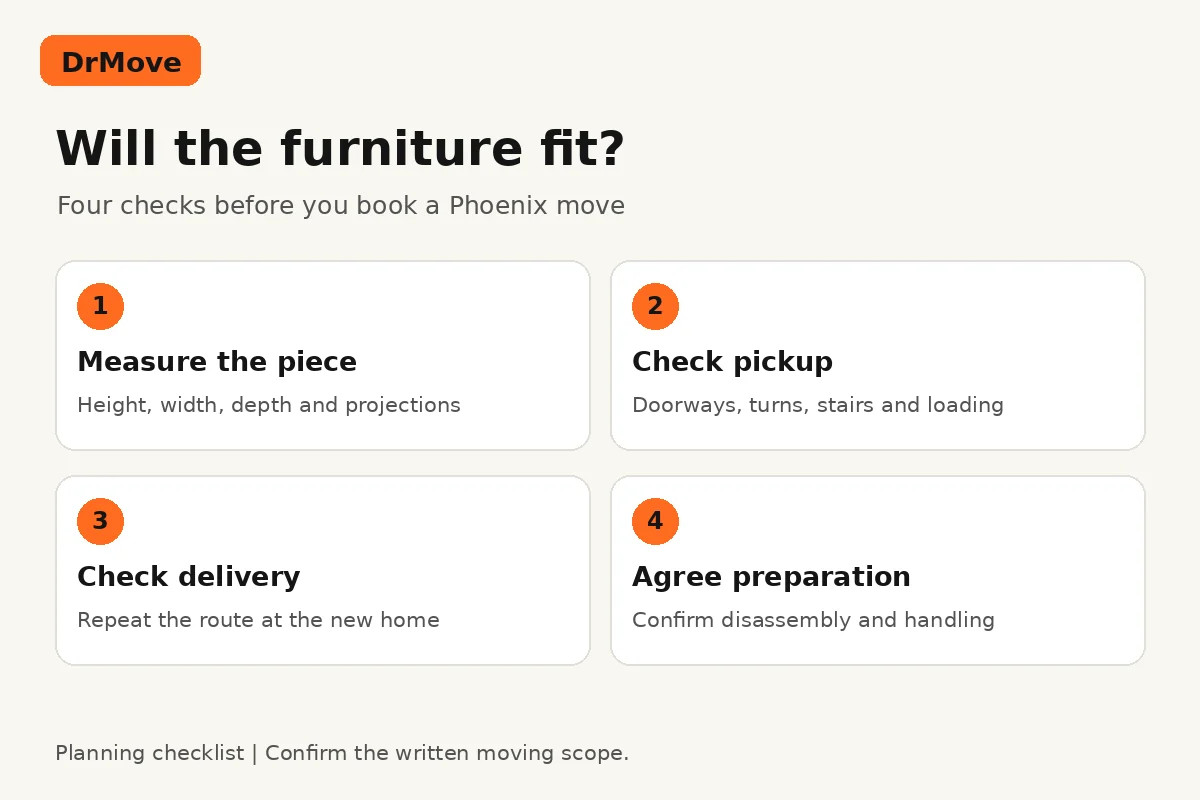
Start with a furniture list that identifies the actual pieces
Write down each large piece separately. “Bedroom furniture” is too broad when the bed separates into several components but the wardrobe stays assembled. Use plain descriptions such as three-seat sofa, corner sectional with detachable sections, dining table with removable legs, or tall cabinet with glass doors. Include the material when it affects handling: solid wood, glass, stone, or a combination.
Give each item a destination room. A dresser going upstairs needs a different route review from one staying on the ground floor. If you have not decided where something belongs, mark that decision as open. Avoid asking the crew to solve the household layout after unloading begins. A simple destination list makes both the quote discussion and delivery more concrete.
Count pieces that appear attached. A sectional might consist of three modules and an ottoman. A bed might include a headboard, footboard, rails, slats, and under-bed drawers. Recording these parts does not mean they all need separate pricing; it helps the provider understand what must be handled and prepared.
Measure the furniture in its planned transport condition
Use a tape measure and record units consistently. Capture height, width, and depth. Note whether your measurements include feet, handles, decorative trim, or cushions. A wide armrest or projecting hinge can matter when the overall furniture dimensions look close to the opening dimensions.
If a manufacturer provides dimensions or disassembly instructions, retain them with your notes. Distinguish the assembled size from the size after an approved part is removed. Do not assume that a sofa’s legs detach or that a cabinet can safely come apart. Some joints, finishes, and older repairs do not tolerate repeated disassembly well.
Write an uncertainty beside any measurement you cannot obtain accurately. For example: “Cabinet approximately 78 inches tall; top molding projects beyond the sides.” An honest approximate measurement gives the provider a question to resolve. A precise-looking guess can create false confidence. Photographs can supplement dimensions when requested through the quote process, but they do not replace them.
Walk the full route at the pickup property
Start where the furniture sits and follow the path to the anticipated legal loading location. Record room doors, corridor turns, exterior doors, stairs, gates, and changes in level. The narrowest point might be well beyond the front door. Include handrails, fixed shelves, wall-mounted fixtures, and low ceilings along the route.
Measure the usable opening rather than the outside of the door frame. A partially opening door can leave less clear space than its nominal width suggests. Record whether something prevents the door from opening fully. Do not remove doors or fixtures without the property owner’s permission and an agreed plan for protecting and restoring them.
Observe the walking surface too. Loose gravel, a steep driveway, an uneven path, or a long corridor belongs in the access description. These conditions do not tell you what equipment a crew will use, but they help the provider assess the job. Describe the actual situation rather than calling it “easy access.”
Give turns and stairs their own notes
A straight opening and a right-angle turn present different problems. Record corridor width and the space available on both sides of a turn. Note any landing where furniture would need to change direction. A photograph taken from a useful angle can show the relationship between openings, provided it does not expose access codes or private paperwork.
For stairs, describe flights, landings, ceiling clearance, handrails, and any winding sections. State whether the item begins or ends on a different floor. “One staircase” can mean a short straight flight or a narrow stairway with a tight turn. A provider needs the physical details rather than an optimistic label.
Do not perform a test carry to find out whether something fits. Measuring an access route is a planning task. The moving team should decide what handling method is suitable and whether a piece requires another solution. If the route seems doubtful, flag it before booking and ask for a written handling decision.
Check the destination before committing to the piece
Repeat the route walk at the delivery address whenever you can access it with permission. Confirm the entrance you will actually use. A wide garage opening may not help if the route from the garage into the house is narrow. In an apartment, the loading entrance may differ from the entrance used for a property tour.
If you cannot visit, ask the property manager for relevant dimensions and current moving instructions. A floor plan can help with room layout but may omit door clearances, stair geometry, or obstructions. Label information supplied by someone else so you know which details still need verification.
For an elevator, ask about the usable cab opening, interior dimensions, loading rules, and reservation process. Do not assume a passenger elevator is available for furniture transport. Refer to the Phoenix apartment moving guide for the broader building coordination checklist, then keep your furniture-specific measurements beside that plan.
Decide what requires disassembly and who does it
Make a separate preparation list instead of burying disassembly inside the furniture inventory. Identify the item, the proposed preparation, who will perform it, and who will reassemble it. Ask whether the provider offers the work and whether it is included in the written quote. General moving service should not be treated as an automatic promise of every furniture preparation task.
Check whether specialist knowledge is needed. Wall-mounted units, complicated adjustable beds, connected appliances, and items fixed to the building deserve a separate discussion. Do not assume that disconnecting utilities, removing built-ins, or reinstalling anchored furniture is part of a household move.
For agreed owner preparation, keep fasteners in a labeled container linked to the item. Save instructions where they remain accessible. Avoid attaching hardware in a way that can scratch a finish or damage upholstery. If you lose a critical component, disclose that before the crew arrives so reassembly expectations can be updated.
Make a fit decision before a moving-day crisis
Use three categories: route appears feasible for provider review, additional information needed, and alternative required. The first category is not a guarantee. It means you have collected enough facts for a meaningful discussion. The second category needs a named next step, such as getting elevator dimensions from the building manager.
An alternative might be leaving the piece behind with permission, selling it before the move, choosing a different destination room, or obtaining specialist handling advice. Do not promise yourself that a balcony, window, or improvised lifting method will solve the problem. Those approaches can require permissions, equipment, and expertise that the quoted move does not include.
Set a decision deadline. If the cabinet cannot be confirmed before booking, tell the provider it is unresolved rather than silently leaving it on the final inventory. Once a decision changes what will move, update the inventory and request a scope review. The written agreement should describe the plan you actually intend to carry out.
Use a short furniture access sheet
A useful access sheet has one row per difficult piece. Include the item name, dimensions, pickup room and floor, destination room and floor, narrowest known openings, relevant turns, planned preparation, and unanswered questions. Put the date on the sheet so an older version does not get mistaken for the final plan.
For example, imagine a sectional moving from a Phoenix apartment to a ground-floor home. Your sheet might identify two detachable modules, a tight corridor outside the apartment, an elevator requiring confirmation, and a clear destination room. That is a hypothetical planning example, not a claim that every sectional or apartment can be handled the same way.
Keep the sheet brief enough to use alongside the complete room-by-room inventory. It adds detail for exceptions without replacing the rest of the household list. The provider still needs boxes, ordinary furniture, locations, services, and the requested date to assess the entire move.
Connect your measurements to the written quote
DrMove’s AI-powered online quoting approach is built around an agreed inventory, services, and conditions without an in-home sales estimator. Accurate furniture information supports that approach. It does not eliminate the need to resolve an uncertain route or confirm whether a requested handling service is available.
The current online form starts a quote request for review. It does not itself issue a binding price, authorize payment, or reserve a truck. Review the written quote and booking terms before agreeing. A binding price covers the agreed move; changing furniture, access, stops, or services can require an updated written quote before the move.
Check that unusual pieces and their agreed preparation appear in the scope. Ask what remains excluded and what information is still required. If the destination changes, repeat the route review for the difficult items. A measurement sheet for one building cannot establish fit in another building, even when both addresses are in Phoenix.
Finish with a clear readiness check
Before moving day, confirm the furniture decisions, approved preparation, accessible instructions, and current inventory version. Keep the route clear without blocking shared exits or ignoring building rules. Leave handling choices to the agreed provider and report any newly discovered obstruction promptly.
A furniture measurement plan gives you something more useful than hoping the biggest piece will fit. It helps you compare the actual work, make keep-or-replace decisions early, and describe the move accurately. Your next step is to turn those details into a written scope that matches both properties.