
When you compare Scottsdale moving companies, “packing included” should lead to a more specific conversation. Does it mean the crew packs every room, protects furniture for transport, supplies empty boxes, or handles only selected fragile items? Those are different jobs. A household can be ready for loading while still needing packing help, and a pile of packed boxes does not tell a provider who will prepare mirrors or dismantle a bed.
This guide helps you create a packing responsibility plan before requesting a move. It complements the broader Scottsdale moving information by focusing on who does each preparation task, what materials are needed, and how the handoff works. Treat every optional service as a question until availability and inclusion are confirmed in writing.
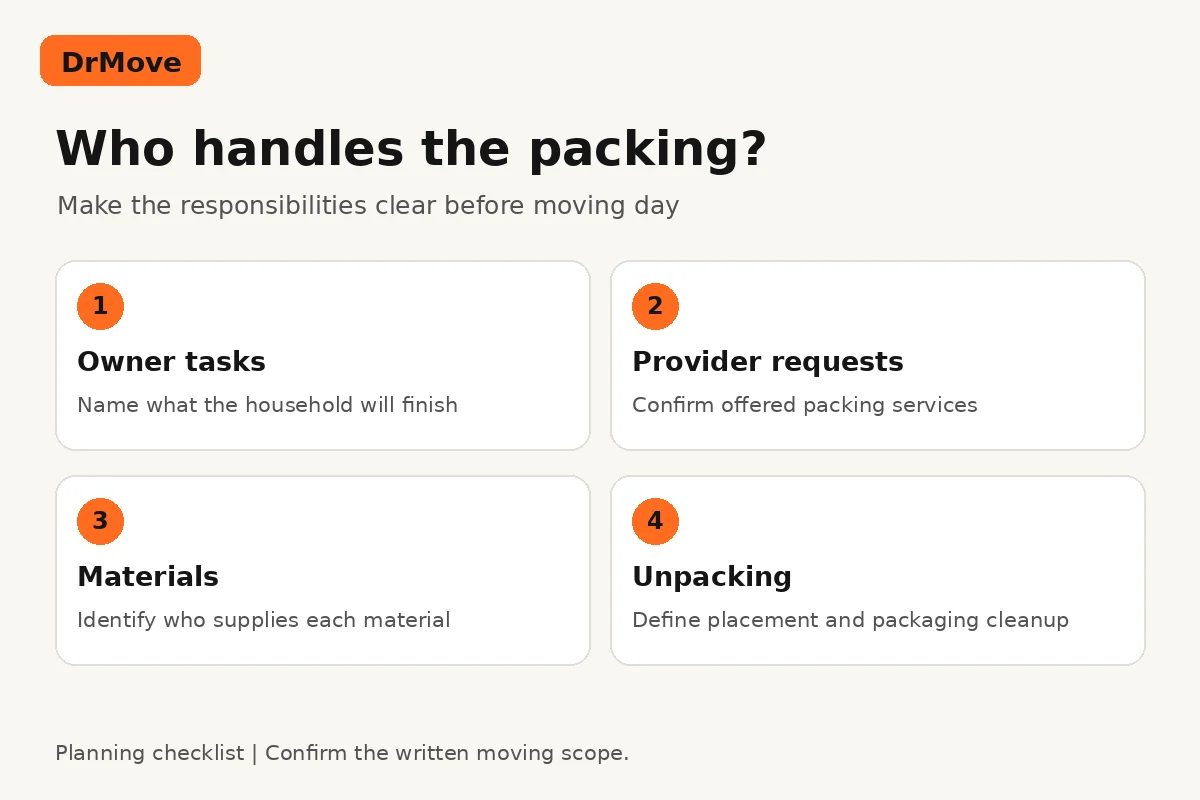
Separate packing from protecting furniture
Packing usually concerns preparing loose household belongings for transport in suitable containers. Furniture preparation can involve protecting surfaces, dealing with detachable components, and agreed disassembly. A provider may describe these tasks differently, so ask what each term means in the proposed service. Do not rely on one broad phrase to cover the entire house.
Walk through a room and identify examples. Books need containers. A television may need an appropriate transport plan. A glass tabletop needs a separate handling discussion. The dining table may need preparation even when every kitchen item is already boxed. List those differences so the provider can explain what is available and what it costs.
Also distinguish loading from packing. Booking help to load belongings does not necessarily include time or materials to finish unprepared rooms. If packing is incomplete, tell the provider before moving day. That allows a scope discussion while there is still time to decide how the work will be completed.
Choose a responsibility model room by room
You do not have to make the same packing choice for every space. One household might pack books and clothing itself while requesting help with kitchen contents. Another may want more extensive packing assistance, subject to provider availability. Build the plan around your time, belongings, and comfort with preparation rather than assuming that a service label solves every room.
Use four columns: area, owner tasks, requested provider tasks, and unresolved items. Include cupboards, closets, drawers, balcony storage, and any separate storage locker. “Kitchen complete” should mean the same thing to both parties. If several cupboards remain untouched, record that instead of considering the room finished because the countertop is clear.
Keep personal essentials separate from the packing assignment. Decide what travels with you and remove it from the rooms being packed. Identity documents, keys, daily electronics, and immediately needed personal belongings should not disappear into a box simply because nobody identified them before packing began.
Estimate materials after sorting the belongings
Box counts are more useful after you decide what will move. Emptying one closet can reveal both forgotten belongings and items you no longer want. Separate keep, leave, donate, and dispose decisions before estimating containers. Do not count on donation or disposal being part of the moving service unless it is specifically confirmed.
Record what materials you already have and whether they are usable. A crushed box or a damp container is not equivalent to a sound box. Ask the proposed provider about suitable materials for the belongings and packing method being discussed. Avoid treating a random collection of containers as a completed materials plan.
Clarify who supplies boxes, protective materials, labels, and any specialty containers. Ask whether supplies are included, separately charged, or supplied only for particular tasks. If you plan to purchase materials yourself, confirm the expectations before buying. This helps prevent duplicate purchases and reduces the chance that the packing team arrives without what the agreed job requires.
Describe fragile and unusual belongings individually
List fragile or unusual items outside the general room total. A cabinet containing everyday dishes is different from a cabinet containing delicate collectibles with unusual shapes. Describe what needs attention without inventing a value or assuming that every moving company has the same handling capabilities.
Ask whether the item can be accepted, what preparation is required, who performs it, and what conditions apply. If an item needs a specialist, obtain that answer before relying on the general household move. Do not assume that a standard packing appointment includes custom crating, artwork installation, appliance work, or technical setup.
Photographs and dimensions can support the discussion when requested through the quote process. Share only what is needed to assess the belongings. Avoid including private documents in background shots. Keep any specialist instructions with the written plan so they do not remain in a separate message that the people preparing the move never see.
Schedule packing around access and daily life
Decide whether the requested packing work would happen before loading day or as part of the same appointment. Ask what is actually available rather than assuming either arrangement. A packing schedule needs access to the rooms and enough preparation by the household to make the agreed work possible.
For a Scottsdale condo, coordinate this schedule with the building’s current rules. A packing visit and a furniture loading appointment may involve different access needs. Ask the property manager which requirements apply. The Scottsdale apartment and condo guide covers the wider elevator, loading, and reservation discussion.
Plan which items remain in use until the last evening. You might keep a small set of dishes and a clearly separated first-night kit while the rest of the kitchen is prepared. Identify who packs those final items and when. Last-use belongings are easy to overlook when a schedule says only “finish packing Thursday.”
Agree on labels that support delivery
Label boxes for the destination rooms, especially when the new home has a different layout. “Office” works better than “back bedroom” if the back bedroom will become a child’s room. Establish a short list of destination names and use it consistently on the inventory, boxes, and floor plan.
Choose labels that communicate enough without advertising sensitive contents. A numbered box index can help you find important items without writing detailed private information on every exterior surface. Keep the index accessible to the household coordinator. The point is to support unloading and unpacking, not to create an administrative project you cannot maintain.
Clarify whether the provider labels boxes it packs and how those labels will match your room plan. If owner-packed boxes are already labeled differently, resolve the mismatch before loading. A simple change from “Room 2” to “Upstairs office” can prevent repeated questions at the destination.
Define unpacking as a separate scope
Unpacking can mean opening boxes, placing contents on a surface, arranging items, or removing used materials. Those are distinct tasks. Ask exactly what is offered and whether it is included in your move. Do not assume an unpacking service means the home will be fully organized when the crew leaves.
Decide what you actually want help with. You might want kitchen boxes opened but prefer to arrange cupboards yourself. You might need furniture placed before any boxes are opened. Write the order so unloading does not block the spaces needed for unpacking. Keep walkways and shared areas usable throughout the process.
Ask who handles empty boxes and packaging. If the provider does not remove them, make your own plan consistent with the building and local collection arrangements. Do not promise a specific disposal method before checking the current rules for your address. Packing waste can occupy more space than expected in a small apartment.
Review a realistic responsibility example
Imagine a hypothetical household moving from a Scottsdale condo to another Valley home. The household packs clothes and books, asks whether kitchen packing is available, and keeps documents and first-night items with it. The furniture list includes a bed needing an agreed preparation plan. Unpacking is not requested.
A clear written plan would identify the kitchen contents, materials supplier, packing date or sequence, labeling method, and furniture preparation responsibilities. It would also state what the household must finish before loading. The building’s access requirements would be confirmed separately. The example illustrates the questions to resolve; it does not describe a package DrMove automatically supplies.
If the household later asks for the entire home to be packed, that is a scope change. It should be reviewed before the appointment rather than treated as a small verbal addition. More belongings, preparation work, supplies, or service time can change the plan that a binding quote originally covered.
Connect the packing plan to DrMove’s online quote
DrMove’s approach uses AI-powered online quoting to work toward a binding written price for agreed inventory, services, and conditions without an in-home sales estimator. Your packing responsibility plan provides information that a broad home-size label cannot. It explains the work you are requesting and the preparation you will complete yourself.
The current quote page collects a request for review. Submitting it does not itself produce a binding price, make a payment, or book the move. Review the written quote and booking terms before agreeing. Ask whether each requested service is available, included, excluded, or still awaiting information.
Use the binding moving quote checklist when reviewing the result. Check inventory and locations alongside packing, materials, furniture preparation, and unpacking. A binding price applies to the agreed scope. If your responsibilities change, request an updated written quote before the move so both sides work from the same version.
Make the final handoff specific
Before the appointment, check each room against the responsibility plan. Identify unfinished owner tasks honestly. Keep household essentials separate, provide the destination room list, and make the agreed packing areas accessible. Tell the provider about new belongings or changed service needs early enough for review.
The most useful packing plan answers a handful of practical questions: what gets packed, who does it, what materials are supplied, when preparation happens, and what happens after delivery. Those answers make comparing Scottsdale movers more meaningful because the proposed companies are assessing the same work. They also give you a clear household checklist before moving day arrives.