
A garage can contain more moving work than several rooms inside the house. Shelves hold mixed containers, tools sit in cabinets, and long objects are tucked behind furniture. When requesting Phoenix movers, do not describe that space simply as “a few garage things.” A useful garage plan identifies what will move, what requires a separate decision, and how the accepted belongings will be prepared.
This guide focuses on garages and household workshops as part of a local move. It does not establish that a provider accepts every tool, machine, chemical, or oversized object. Use our Phoenix movers page for your overall request, then add the garage details that a bedroom count cannot show.
Divide the garage into useful inventory zones
Start with the actual areas where belongings are stored: wall shelving, freestanding cabinets, workbench, overhead storage, outdoor-equipment corner, and loose items along the floor. Use only the zones that exist at your property. This is a way to avoid omissions, not a requirement to rearrange everything before you can request a quote.
Record the larger pieces in each zone individually, then count clearly described groups of smaller belongings. “Two freestanding metal cabinets and eight packed tool cartons” is more useful than “workshop.” State whether containers are already packed and whether the contents are known. A storage tote full of lightweight decorations differs from a similar-sized tote full of metal components.
Identify areas you cannot inspect safely, including overhead storage or unstable stacks. Do not climb or pull objects down simply to improve the inventory. Mark the information as incomplete and discuss how to resolve it. Our room-by-room moving inventory guide provides the broader framework; a garage zone list adds the detail needed for this particular space.
Decide which belongings still justify moving
A garage often preserves unfinished projects and duplicate equipment long after the household has stopped using them. Make keep, sell, donate, and separate-disposal decisions before final packing where possible. Set a deadline for unresolved pieces so they do not drift between “probably staying” and “probably moving” throughout the quote discussion.
Check the destination before keeping large storage furniture or a workbench. Measure the available space, consider the intended use, and identify the route into that space. An item that fits in the current garage may be awkward in a smaller garage, shed, or upstairs hobby room. A deliberate destination decision can save preparation work on something you cannot use.
Do not assume the moving company will remove unwanted items, deliver donations, or dispose of project materials. Those are separate service questions. Confirm each requested task and destination before adding it to the job. If you want to reduce the household load more broadly, our downsizing guide explains how to settle keep-or-remove decisions before finalizing the inventory.
Separate chemical and uncertain contents from ordinary goods
The garage deserves a separate review of products stored in cans, bottles, and other containers. The EPA’s household hazardous waste guidance identifies products such as some paints, cleaners, oils, batteries, and pesticides as needing special care. That is a reason to identify the contents and obtain appropriate guidance rather than mixing everything into general moving cartons.
Ask the moving provider for its current acceptance and preparation rules. A product being common in a home does not establish that it is accepted on the moving vehicle. Do not conceal an uncertain container inside a toolbox or describe it as ordinary miscellaneous belongings. Give the provider accurate information so it can tell you what belongs outside the accepted household shipment.
For unwanted or unidentified products, consult the relevant local waste authority about current options. Do not improvise disposal or chemical-handling procedures to clear the garage quickly. Keep this task separate from the furniture-moving appointment. The provider should not arrive expecting prepared household goods and discover that the remaining work is an unresolved waste or product-identification problem.
Review machines and heavy tools individually
List substantial tools or equipment by type and, where available, model, approximate dimensions, and known weight information. State whether the item is freestanding, fixed to a bench, connected to a service, or assembled from several sections. If you do not know the weight, say so rather than assigning an optimistic number that looks precise.
Find the manufacturer’s preparation and transport guidance for equipment that needs it. Ask who will perform any required preparation and whether the moving provider accepts the item afterward. A household mover should not be assumed to offer machinery relocation, specialist rigging, utility disconnection, or technical recommissioning. Obtain a separate arrangement when the job needs expertise beyond the accepted moving service.
Flag accessories that travel with the equipment, including stands, guards, attachments, or detachable components. Record how they will be packed and identified without giving a do-it-yourself dismantling instruction. Missing an essential part can make equipment unusable at the next home even when the main unit arrives. Keep the responsible preparer’s instructions available for the destination handoff.
Make cabinets and small parts understandable
Tell the provider whether cabinets contain tools, hardware, or other goods and ask what must be removed before handling. Do not assume a full cabinet can be moved intact because it has wheels or has been shifted around the garage before. The provider needs to assess the actual furniture, contents, route, and preparation requirements.
Keep small components organized in suitable containers that identify their contents and intended destination. A collection of mixed screws, sharp components, and loose tools becomes harder to account for when transferred into an unmarked carton. Ask the provider what packing it accepts and identify who will do the work. Do not pack to a self-invented weight limit or assume the same carton suits every group of items.
Keep labels factual rather than decorative. Identify the cabinet or project a container belongs with, and distinguish items you will carry personally from the crew’s accepted load. Use the same names in the inventory and on the packaging. A useful system should still work when a helper who has never used the workshop reads it.
Include long, awkward, and outdoor items
Look beyond the workbench for ladders, shelving sections, garden equipment, bicycles, sports storage, and other objects that do not fit a normal carton. List the actual quantity and approximate dimensions where relevant. Tell the provider if a long piece is behind other belongings or must come through an interior doorway rather than directly out of the garage.
Identify anything fixed to the building or attached to other equipment. Removal and reinstallation are not automatically part of household transport. Confirm permissions, preparation responsibilities, and any specialist involvement before moving day. A wall-mounted storage system may need a different plan from a freestanding shelf, even if the two hold the same boxes.
Check whether an outdoor or utility item contains material that affects acceptance. Ask the provider for instructions specific to the item rather than applying a general garage rule. Do not perform unfamiliar fuel, battery, pressure, or electrical work based on a moving checklist. The planning goal is to surface these questions early and assign them to the appropriate person.
Describe access beyond the garage-door opening
Record the approach from the anticipated legal loading location to the garage and the route to larger pieces. Note driveway slope, surface changes, gates, steps, narrow passages, and the space available around stored equipment. A wide vehicle door does not help if a heavy cabinet is trapped behind an immovable workbench.
Review the destination route with the same care. The next home may require carrying items through a side gate, down a path, or into a room inside the house. Our furniture route measurement guide explains how to describe openings and turns. Leave handling methods to the provider rather than attempting a test carry to prove that something will fit.
Agree on a clear working area without creating unsafe piles or blocking shared access. If the garage must remain in use until shortly before pickup, explain which preparation steps are still pending. A provider can assess a realistic readiness plan more easily than a promise that a crowded space will somehow be cleared on arrival.
Organize the garage at the destination
Give each major group a destination zone: workshop cabinet area, household storage, sports equipment, or another clearly named space. Decide the position of bulky furniture before small cartons fill every corner. Tell the moving contact which items need access for later installation or preparation by another professional.
If some belongings will go to storage or another address, add that stop to the original request. Do not treat it as a minor routing change after loading. The multi-stop moving guide explains how to connect item assignments, access, and the complete itinerary. Clear destination information prevents garage cartons from being unloaded into whichever space happens to be open.
Keep a short exception list for equipment awaiting specialist setup, containers carried separately, and unresolved inventory decisions. Give each exception an owner and next step. This makes it possible to complete the household move without pretending every workshop task will also be finished by the moving crew that day.
Connect the plan to your written moving scope
When comparing Phoenix moving companies, give them the same garage inventory and preparation information. An assessment that includes packed household storage is different from one involving heavy equipment or additional handling. Ask what is accepted, what is excluded, who prepares each item, and how changes are reviewed before they become part of the job.
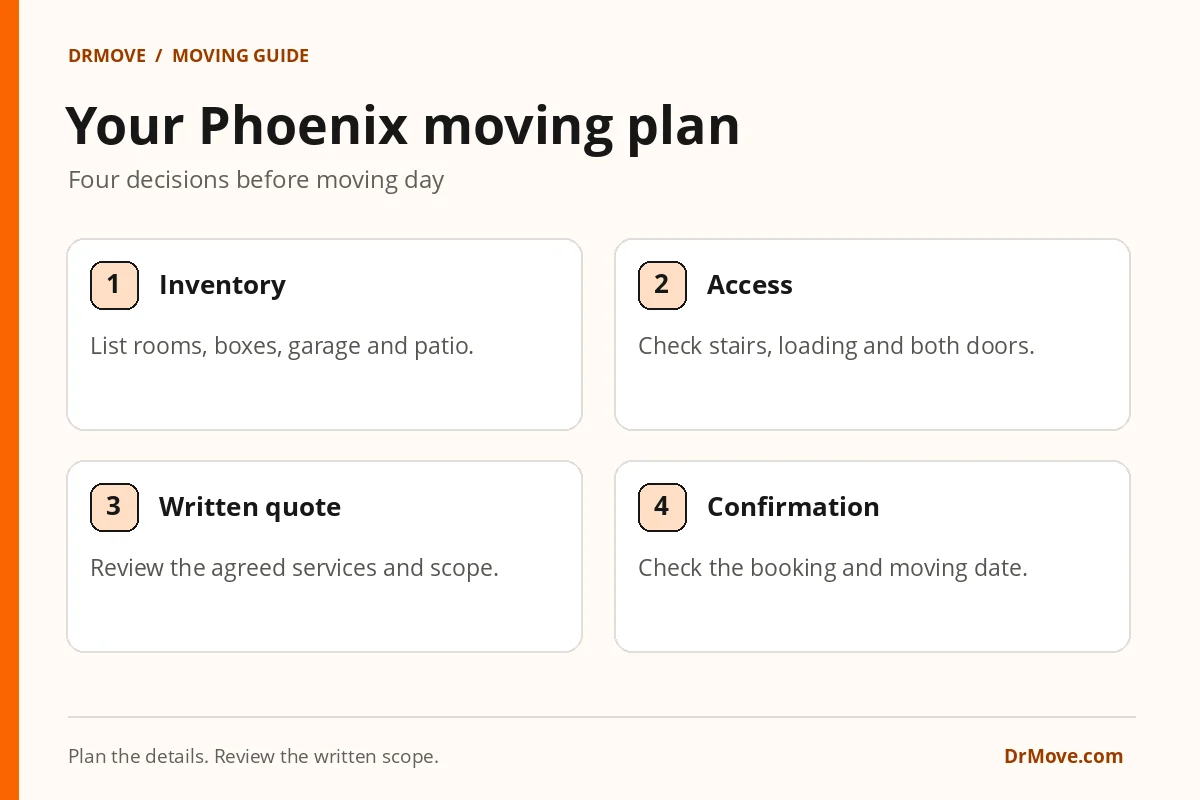
DrMove’s AI-powered online binding-quote approach is based on the agreed inventory, services, and conditions without an in-home sales estimator. Include the garage when starting online. The current form collects a request for review; submission does not itself issue a binding price, reserve a truck, or authorize payment. Review the written quote and booking terms before agreeing.
Changes to the load, access, stops, or services may require an updated written scope and quote before the work changes. Finish with an accurate inventory, resolved acceptance questions, prepared belongings, and a destination plan. A garage move becomes more manageable when its contents are described as real items and responsibilities rather than a last-minute pile outside the house.