
A bed can look like one inventory item while the move involves a mattress, foundation, frame, drawers, headboard, powered components, and a collection of small parts. Before hiring Phoenix movers, identify the actual setup and agree on who prepares it, who handles each part, and what reassembly is included at the destination.
This guide helps a household organize beds and mattresses for a moving quote. It is not a universal disassembly manual or a promise that every bed can be handled by a general moving service. Begin with our Phoenix movers page, then give the provider the model and preparation details that a phrase such as “one king bed” leaves unanswered.
Describe the complete sleeping setup
List each bed by room and identify its main components. State whether there is a separate mattress, foundation, platform, frame, headboard, footboard, or storage unit. Describe split sections and additional pieces where relevant. A provider should not have to infer the contents of a bedroom from the size label on the mattress.
Mention features that change preparation or handling: built-in drawers, a lift-up storage section, wall attachment, a tall upholstered headboard, powered movement, or connected controls. If you do not know how the bed is assembled, mark that as an open question. Do not assume that an unfamiliar fitting will be easy to disconnect when the crew arrives.
Give each component its destination room and floor. A frame remaining on the ground floor presents a different route discussion from one going upstairs. Add these details to your household inventory rather than keeping the bedroom list in a separate message that might not reach the person reviewing the quote.
Find the correct instructions before taking anything apart
Locate the manufacturer and model information where it is accessible without unsafe lifting. Check your purchase records or existing instructions if the label is difficult to reach. Obtain the instructions for the actual frame, base, and mattress system. Similar-looking beds can use different fasteners, connections, and preparation requirements.
As an example, Sleep Number’s moving and reconnecting guidance directs owners to instructions appropriate to the mattress and base model. The useful lesson is to identify the system before preparation. Do not apply advice for a conventional frame to a powered or connected bed merely because both fit the same mattress size.
Share relevant manufacturer requirements with the person responsible for preparation and ask the moving provider what information it needs. If instructions are missing or the configuration remains uncertain, resolve that before pickup. The moving quote is easier to assess when the provider knows whether it is receiving prepared components or being asked to undertake a specific accepted task.
Assign disassembly and reassembly as separate services
Ask whether the provider offers disassembly for your particular bed and whether that work is included in the written quote. Identify the exact task rather than assuming the phrase “bed moving” covers everything. Removing ordinary frame components differs from work on mounted furniture, complex mechanisms, or equipment requiring specialist knowledge.
Confirm destination reassembly independently. A provider may accept transport without accepting every setup task, and a part removed by the owner may need the owner’s instructions for later assembly. Write down who will perform each task and what must be ready for that person. Do not let an unspoken expectation of a fully operational bed become the final moving-day surprise.
Ask how the provider handles damaged fasteners, missing parts, previous repairs, or a frame that does not come apart as expected. Disclose known problems during the quote discussion. A piece can remain usable in its current room while still being unsuitable for the originally imagined disassembly plan. Give the provider an opportunity to review that uncertainty before it becomes urgent.
Treat powered and connected systems individually
Identify adjustable bases, controllers, remotes, cables, and other system-specific components. Tell the provider which items belong together and who will prepare them according to the manufacturer’s instructions. Do not assume an ordinary furniture crew also provides electrical repair, technical installation, app setup, or troubleshooting for a connected bed.
Keep the household’s accounts and private access information under your control. A moving team does not need passwords to transport physical belongings. If technical assistance is necessary, arrange it with the appropriate provider. Describe any agreed physical preparation separately from the work required to make the system function after delivery.
For an unfamiliar mechanism or integrated feature, ask the manufacturer or an appropriate professional for guidance instead of experimenting. Do not disconnect components at random, force a mechanism, or improvise a way to lock it for transport. The customer’s planning responsibility is to identify the system and assign preparation, not to replace model-specific expertise with a general checklist.
Check the route for the largest component
Measure the pieces in their planned transport condition where that information is available. An assembled frame may become smaller components, while a large headboard or base section may remain substantial. Identify which dimensions are confirmed and which are estimates. Do not assume a mattress or powered base can be bent, folded, or altered to solve a tight route.
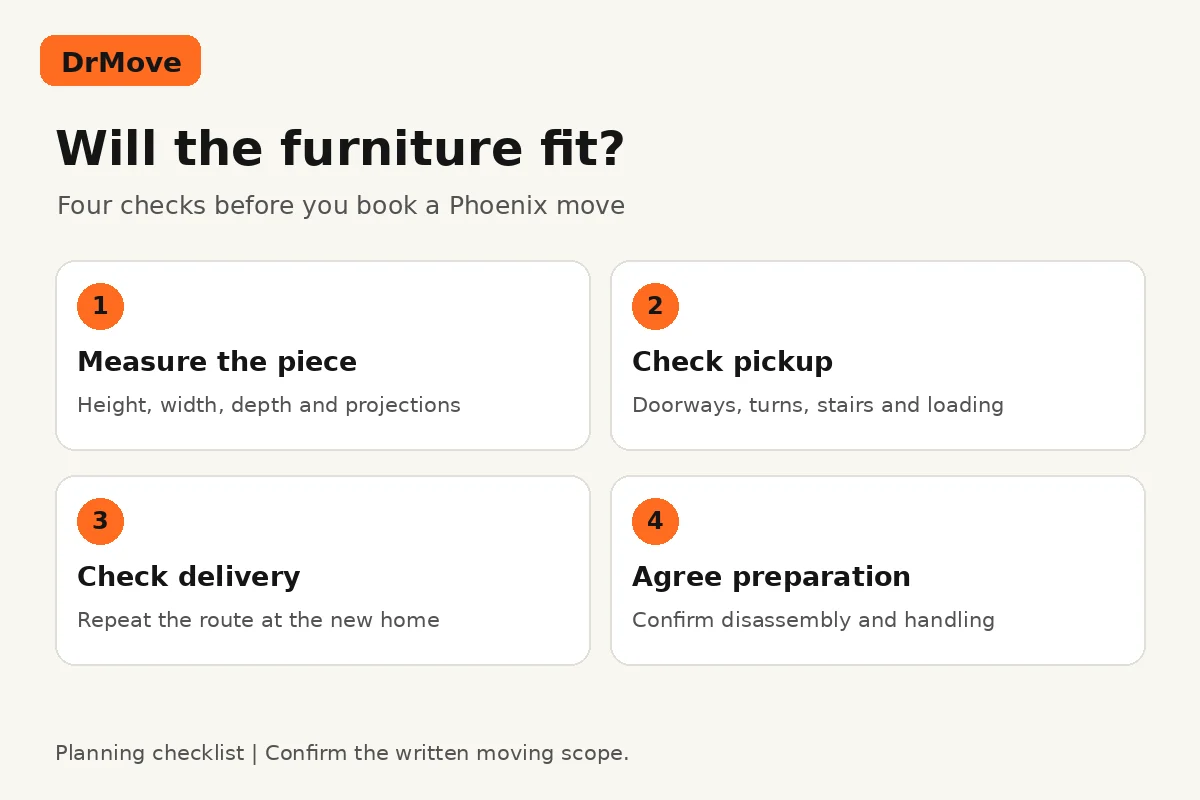
Describe the pickup route from the bedroom to the loading location, including doors, corridor turns, stairs, lifts, and changes in level. Repeat that review at the destination whenever you can access it with permission. Our furniture route measurement guide explains what information to collect while leaving the actual handling method to the provider.
If a piece seems unlikely to fit, flag it early. A window, balcony, removed fixture, or alternate entrance is not an automatic solution and should not be promised as part of the move without review. Ask the provider what additional information it needs and whether a different service or furniture decision is necessary.
Agree on mattress protection and condition
Tell the provider the mattress type and size and ask what preparation and protection it accepts. Confirm who supplies the appropriate packaging and who applies it. Do not assume that any large bag or blanket will meet the requirements for the particular item and service. Follow manufacturer guidance where it addresses moving or storage.
Disclose existing damage or another condition that may affect acceptance before pickup. Keep the discussion factual and ask what the provider requires. A mattress being present in the home does not establish that it is accepted for transport under every circumstance. Resolve the question through the provider’s stated process rather than concealing an issue inside packaging.
Record visible condition where useful without moving a heavy or unstable component to obtain photographs. Keep personal belongings and private paperwork out of the background. A condition record supports an accurate handoff; it does not establish product performance, guarantee protection, or replace the written terms governing the move.
Keep hardware linked to the correct bed
Label removed hardware by the bed and component it belongs with. Identify who is keeping it and how it will reach the person doing reassembly. A household with several frames can easily confuse similar-looking fasteners. Do not combine every piece of bedroom hardware into one unmarked container and expect the destination assembler to reconstruct the history.
Keep assembly instructions accessible, including any diagrams relevant to the accepted task. Note a missing or damaged part before the move. Avoid substituting a different fastener simply because it appears to fit; use the appropriate manufacturer or professional advice. The moving service should not be expected to manufacture missing parts or correct an undocumented repair.
If components will travel separately, make that explicit in the inventory and handoff plan. A headboard carried in one vehicle and rails in another still need to reach the same destination arrangement. Use stable identifiers, such as main-bedroom frame or guest-room frame, that make sense to everyone helping with the move.
Prepare the destination room before setup
Choose the intended bed position before cartons fill the room. Check that the space is available for the agreed assembly task and that other deliveries will not occupy the same area. If the room is being renovated or remains unavailable, tell the provider before the appointment rather than expecting assembly to occur around an active project.
Distinguish delivery to a temporary room from completed setup in the final room. Later relocation is a separate task unless explicitly included. If some components are going to storage, confirm preparation and storage arrangements separately, including what will happen when they are retrieved. A household moving appointment does not establish storage suitability or reserve an unspecified future return visit.
Keep the person authorized to approve room-placement decisions available. Our move-day contact guide explains how to separate a person who can open the property from a person who can approve changes. A consistent room plan helps the provider carry and place the accepted components without conflicting household instructions.
Build a practical first-night plan
Plan bedding and immediate household needs separately from the frame components and moving cartons. Do not make the entire evening depend on a complex bed being operational at an exact hour that no one has confirmed. Ask when the agreed assembly task is expected to be addressed within the accepted appointment and what remains outside the provider’s work.
If a part is missing or a technical issue prevents completion, follow the responsible provider’s process and arrange the appropriate next step. Do not use an incomplete or unstable setup merely because the rest of the move has finished. The person responsible for assembly or installation should confirm its completed work; a customer’s moving deadline does not replace that handoff.
When comparing Phoenix moving companies, give each the same component list, access details, and requested preparation tasks. A transport-only quote differs from one explicitly accepting disassembly and reassembly. Review included work, exclusions, and how unforeseen preparation problems are handled before agreeing to the appointment.
Put the agreed bed plan into the written scope
DrMove’s AI-powered online binding-quote approach uses the agreed inventory, services, and conditions without an in-home sales estimator. Include beds, unusual bases, and preparation questions in your online request. The current form collects a request for review; submission does not itself issue a binding price, reserve a truck, or authorize payment. Review the written quote and booking terms before agreeing.
Changes to bed components, access, stops, or requested services may require an updated written scope and quote before the work changes. Confirm which pieces are moving, who prepares them, how the parts stay identified, and who completes the destination setup. That turns “move the bed” into a clear set of responsibilities a provider can assess.