
The distance between the moving vehicle and the front door can matter as much as the distance between two addresses. A ground-floor apartment may sit beyond a gate, a courtyard, and a long corridor. A house may have a driveway that the moving vehicle cannot use as expected. Before requesting Scottsdale movers, describe the actual carrying route instead of writing only “ground floor” or “parking available.”
This guide helps you collect access information for the provider’s review. It does not establish a universal definition, distance threshold, fee, or equipment solution for a long carry. Use our Scottsdale movers page for the overall moving request, then add the route details that explain the work between the vehicle and your rooms.
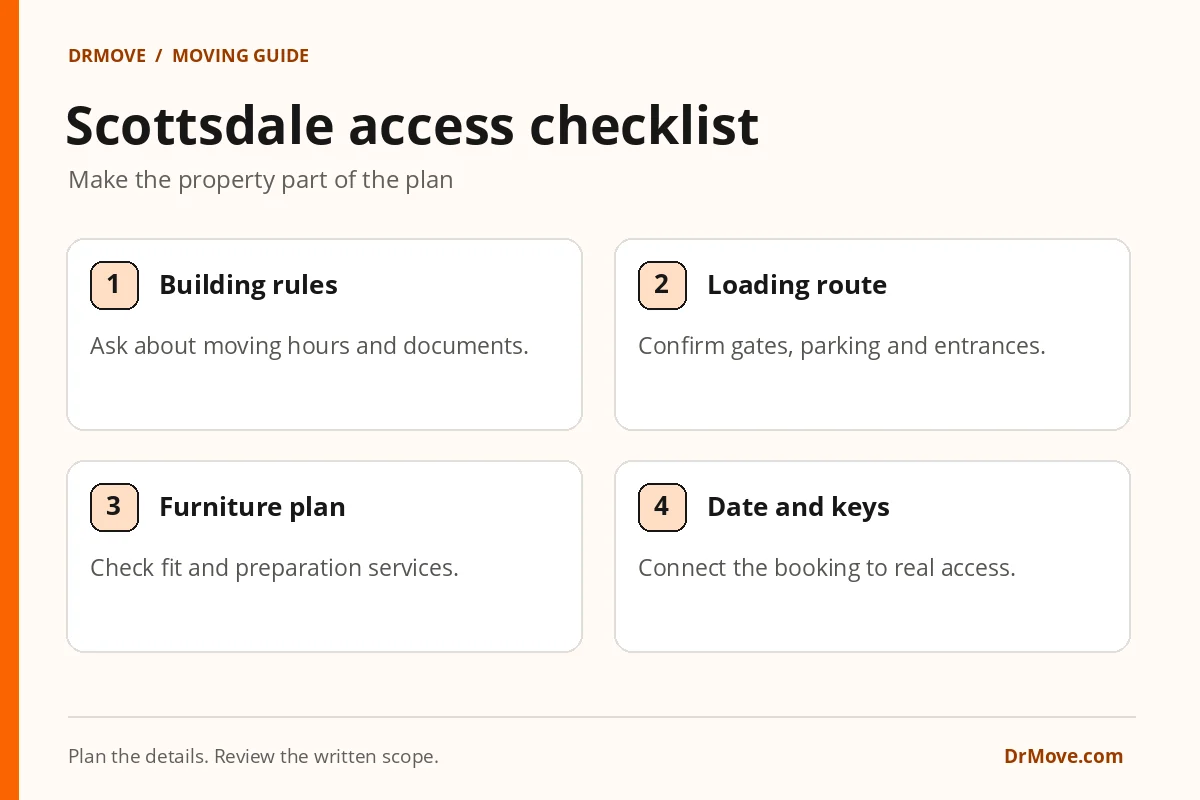
Start at the loading position that can actually be used
Identify the anticipated legal and permitted loading location at each property. Ask the relevant property contact where a moving vehicle may stop, how that location is reached, and whether an advance arrangement is required. Do not assume that a space used by a passenger car is suitable or available for the moving vehicle.
Distinguish confirmed information from a proposal. “Manager confirmed the loading entrance at the east side” is different from “I think the truck can use the driveway.” Give the provider the facts you have and identify what remains unresolved. Let it assess the vehicle and service arrangement rather than promising access on its behalf.
Check the destination as carefully as the pickup. A convenient loading position at the old home says nothing about delivery access. If different people manage the two properties, obtain instructions from each. Keep private access credentials out of public route descriptions and share them only through the provider’s agreed private channel when needed.
Trace every segment between the vehicle and the room
Walk the entire permitted route where you can do so with permission. Include outdoor paths, gates, courtyards, corridors, lifts, stairs, and room entrances. Note transitions between surfaces or levels. A route described as one long hallway may actually include several turns and a separate exterior section that the provider needs to review.
Use plain route segments rather than an optimistic overall label. For example, a hypothetical description could identify a loading bay, a paved path to a gate, a corridor to the lift, and a final hallway to the apartment. This is a planning example, not a claim that a particular Scottsdale building uses that arrangement.
If distances are requested, record them consistently and explain how they were obtained. Distinguish a measured figure from an estimate. Do not invent a precise number based on memory. Ask the provider how it defines and measures the relevant carrying distance for its own written terms so your description answers the question it is actually reviewing.
Describe surfaces and changes in level
Identify stairs, ramps, thresholds, uneven surfaces, gravel, sloped sections, and other conditions along the route. State where they occur and whether they affect the route to every item or only part of the household. Do not treat a route as step-free merely because the apartment itself is on the ground floor.
Describe the available space without prescribing a handling method. A customer should not decide that a cart, dolly, extra vehicle, or improvised ramp will solve a route problem. The provider needs to assess the accepted load, surfaces, clearances, and its own service capabilities. Flag uncertainties before booking so it can request further information.
Do not move obstacles, remove fixtures, or alter shared property without the appropriate permission and an agreed plan. If the route is unsuitable, the answer may be a different authorized entrance or a changed service arrangement. A desired moving date does not make an unreviewed carrying route acceptable for every item.
Give gates and doors their own details
Record the entrances that must be opened, who controls them, and whether someone must remain available to provide access. A gate that closes automatically can create a different coordination question from a freely accessible walkway. Tell the provider about the actual arrangement without posting codes or security information on a shared checklist.
Note restricted opening space, tight turns, low clearances, and any door that cannot open fully. For large furniture, use our route measurement guide to collect the relevant dimensions. A long route is not simply a distance problem if an oversized piece cannot pass a particular opening along it.
Ask the property contact about current requirements for access assistance, door operation, and shared spaces. Avoid assuming that propping a door open is permitted or that another resident will let the crew through. The moving team needs a dependable access plan that works within the property’s actual arrangements.
Separate elevator access from the rest of the carry
An elevator can address a change in floor without eliminating the carrying work on either side. Describe the route from the loading location to the elevator and from the elevator to the home. State whether the building has identified a particular lift or entrance for moving and what remains subject to confirmation.
Ask the building contact about the current reservation process, usable dimensions, permitted moving window, and other relevant requirements. Do not assume a passenger lift is automatically available for furniture. Our Scottsdale apartment moving guide covers wider building coordination; this route description adds the physical detail around the lift itself.
Tell the provider if an elevator arrangement changes or cannot be confirmed. An unplanned stair route may change the accepted service or make the proposed handling unsuitable. Do not present stairs as an automatic substitute after the original arrangement has been accepted. Request a provider review and updated written terms where needed.
Match route questions to the actual inventory
Identify the items most likely to need additional route review: large sofas, tall cabinets, long tables, mattresses, or unusual equipment. Record where they start and where they are intended to finish. The provider should assess those pieces against the complete route rather than assuming all belongings present the same carrying problem.
Include boxes and ordinary furniture in the full inventory as well. A route that is manageable for one item still has to support the whole accepted household job. Do not omit the garage, patio, or storage belongings because your main concern is a large sofa. Our inventory guide helps keep the access discussion connected to the complete load.
Report preparation that changes a piece’s transport dimensions, identifying who performs it and whether it is agreed. Do not promise disassembly that has not been reviewed. For unfamiliar furniture or equipment, use the appropriate instructions and professional advice before deciding that taking it apart will solve the access issue.
Coordinate loading windows without promising arrival guarantees
Identify any confirmed loading window and the person responsible for coordinating it. Tell the provider about competing deliveries, restricted entrances, or another appointment using the same area. A space that is available during your property tour may not remain available during the proposed moving window.
Ask the provider what timing it can accept for the route and load. Do not promise a property manager an exact arrival that the moving company has not confirmed. If access depends on someone opening a loading bay or meeting the vehicle, arrange an accepted contact and backup rather than relying on an informal favor.
If the loading location changes, update the route description too. Moving from an entrance beside the building to a more distant permitted position may change the work even though the postal address remains the same. Inform the provider promptly so it can assess the change before the vehicle arrives.
For example, a hypothetical customer might initially describe a unit as beside the car park, then learn that moving vehicles must use a different entrance beyond a courtyard. The useful update identifies the approved position, the courtyard segment, and the remaining corridor. It gives the provider something concrete to review instead of simply saying that parking is now less convenient. Keep that revised route in every current copy of the plan.
Ask how the provider’s quote treats access
When comparing Scottsdale moving companies, give each the same inventory, route description, floors, and property constraints. Ask what information it needs to define the accepted carrying work. A comparison is less useful when one company has reviewed the complete route while another has received only the phrase “easy ground-floor access.”
Ask how the written quote identifies included access and how changes are reviewed. Do not assume all providers use the same long-carry threshold, charge structure, or terminology. Review the actual offer and request clarification before acceptance. This guide supplies planning questions, not a current market price or a universal policy for moving companies.
If a provider requests photographs or a route sketch, make them specific and current. Show useful context while avoiding private paperwork and access credentials. Identify the date and which property the material describes. An old photograph from another entrance can create false confidence if it is mistaken for the current approved route.
Keep one current access sheet for moving day
Combine the permitted loading location, route segments, relevant distances, openings, floor changes, confirmed windows, and authorized contacts in a short access sheet. Mark unanswered questions clearly. Give the provider the version it requests and keep the household’s copies consistent so different helpers do not give conflicting directions.
DrMove’s AI-powered online binding-quote approach covers the agreed inventory, services, and conditions without an in-home sales estimator. Include carrying routes in your online request. The current form starts a request for review; submission does not itself issue a binding price, reserve a truck, or authorize payment. Review the written quote and booking terms before agreeing.
Changes to loading positions, access, inventory, stops, or services may require an updated written scope and quote before work changes. A useful long-carry plan replaces assumptions with a route the provider can assess: where the vehicle may stop, what lies between it and the rooms, and which conditions will apply on the accepted day.