
Moving into a smaller home creates a decision problem before it creates a transportation problem. You may have enough furniture for several rooms but fewer rooms at the destination. Storage that was convenient in a garage may have no equivalent in an apartment. If you are comparing Phoenix movers while downsizing, deciding what will actually travel can make the quote request clearer and the new home easier to use.
This guide focuses on reducing and organizing belongings before a household move. It does not assume a particular age, family situation, or reason for moving. The goal is a final inventory that reflects the space and routines you are moving toward, rather than every object you currently own.
Define the destination before sorting the old home
Begin with usable spaces, not the advertised number of bedrooms. Note which rooms will have multiple purposes, where storage is available, and which large pieces already have a place. An extra bedroom serving as an office may not have room for a second full bedroom set. A patio may not provide protected storage for belongings currently kept indoors.
Measure relevant rooms and large furniture when you can access the destination with permission. Leave space for opening doors, using drawers, and moving between furniture. A floor plan is a helpful starting point, but it may not show every obstruction or usable clearance. Treat uncertain dimensions as questions to resolve rather than evidence that everything will fit.
Write a short purpose for each space: sleep, work, eat, relax, store household supplies. Then identify the belongings that support those activities. This makes sorting less abstract. You are choosing what the next home needs, not judging whether every object you have owned was a good purchase.
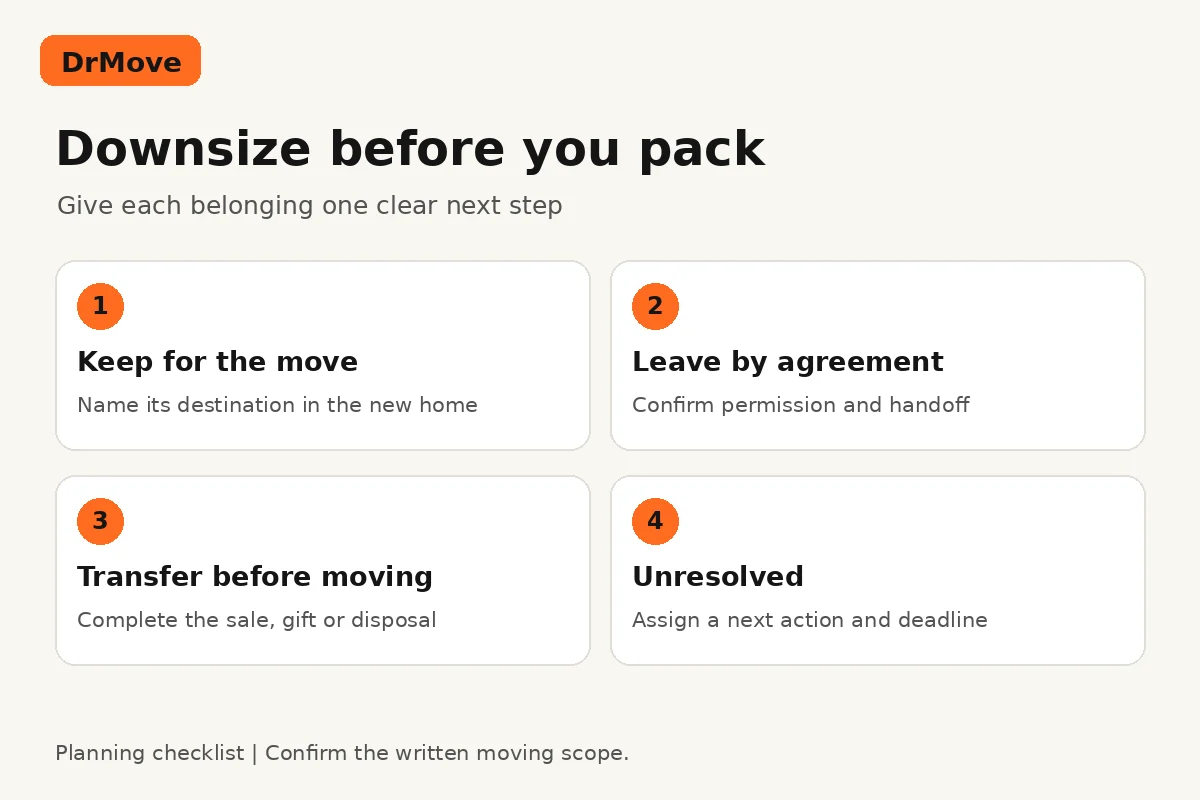
Create four decision groups with clear boundaries
Use keep for the move, leave through an agreed arrangement, transfer before the move, and unresolved. The transfer group can include items you intend to sell, donate, give away, or dispose of through an appropriate route. These are intended outcomes until they actually happen. A table listed for sale is still in your possession and may still affect the move.
Give unresolved items a deadline. Without a date, that category can become the largest group in the house. Record the next action: measure the new wall, ask a family member, check whether the item works, or confirm whether an organization accepts it. Assign a person to each action when several household members are involved.
Do not use the moving truck as a temporary sorting area. Once belongings are packed together, decisions become harder to reverse. Separate the groups physically where practical and use labels that everyone understands. Avoid leaving unlabeled piles near the items that will travel, especially if someone else will help pack.
Start with duplicates and low-conflict spaces
A utility cupboard or a drawer of spare kitchen tools may be easier than photographs or family furniture. Early progress helps you learn how long decisions take without beginning with the most emotional belongings. Work on a small, defined area and finish its decisions before emptying several more spaces.
Look for duplicates that do not serve a current purpose. Two similar chairs may both be useful, while five rarely used side tables may not have places in the new layout. Keep the question specific: where will this item go, and how will it be used? Avoid turning the process into a rigid rule about owning the smallest possible number of things.
Test uncertainty in a practical way. If you think an appliance no longer works, check it safely according to its instructions before treating it as a useful possession or offering it to someone else. Describe condition honestly in any transfer. Moving unwanted belongings to another person should not mean concealing their problems.
Give large furniture a decision sheet
Large pieces deserve early attention because they affect space, access, and transport planning. Record dimensions, destination room, condition, whether the piece separates, and any uncertainty about getting it through the route. A piece can fit the room but still require an access review through doors, turns, stairs, or an elevator.
Compare the cost and effort of keeping a piece with its usefulness in the new home. Avoid assuming that replacing furniture is always cheaper or easier. You may value an existing item for comfort, durability, or personal meaning. The useful decision is the one that reflects your actual space and priorities.
When a piece has no destination, choose a next step before packing begins. If you intend to give it away, confirm pickup arrangements rather than relying on a vague promise. If it will stay at the old property, obtain permission from the person responsible for that property. Unwanted furniture does not automatically become an acceptable part of the move-out handoff.
Separate ownership decisions from household preferences
In a shared home, establish who can decide what leaves. One person may dislike an object that belongs to someone else. Do not sell, donate, or discard another person’s belongings without their authorization. A simple ownership note helps avoid treating shared storage as a collection that any household member can clear.
Discuss shared furniture before scheduling pickups. Write down what will travel together, what will go to separate destinations, and which decisions remain open. If someone is moving only their own belongings, the quote inventory should describe that subset rather than the entire property. This can matter in roommate moves and households separating into different homes.
Keep agreements practical. Identify the item, the decision, the responsible person, and the deadline. You do not need a complicated system, but a record prevents the same piece from being promised to a friend and included in the moving list. For wider household planning, use the Phoenix local moving guide.
Verify transfer and disposal arrangements before relying on them
Donation acceptance, collection appointments, and disposal options vary by item and provider. Check current requirements directly with the organization or service you intend to use. Do not assume that an item will be accepted because a similar item was accepted previously. Condition, size, and available capacity can affect the answer.
For a sale or giveaway, plan a safe and realistic collection arrangement. Keep private documents and valuables out of the collection area. Coordinate access without publishing building codes or unnecessary personal details. Allow enough time for the item to leave before the moving deadline, and decide what you will do if collection falls through.
Do not assume DrMove includes donation runs, junk removal, multiple drop-offs, or disposal in a household moving quote. Ask about any additional stop or service and wait for written confirmation of availability and scope. If you choose a separate service, coordinate its timing so the property is ready for the agreed move.
Pack a smaller home by destination function
Once decisions are made, label boxes for the new layout. Belongings from a large old kitchen might be split between the new kitchen and a utility cupboard. Packing everything according to the old room names can recreate the previous storage problem at delivery. Destination labels make your decisions usable by the people unloading.
Avoid creating boxes labeled only “miscellaneous” when a more useful category is possible. A box of desk supplies and a box of household maintenance items should not require opening five containers to identify them. A simple numbered index helps when you want to keep detailed descriptions off the outside of boxes.
Keep immediate-use items separate. Plan what you need for the first evening, basic cleaning, access to the property, and essential communication. The first-night kit should reflect your household rather than a generic shopping list. Its purpose is to make the destination usable while the rest of the boxes are unpacked deliberately.
Decide whether storage solves a specific problem
Storage can be a practical answer when there is a defined timing gap or a clear reason to keep particular belongings. It can also postpone decisions while adding another location and another stage to the move. Before choosing it, identify which items would go there and when you expect to review or retrieve them.
Compare storage needs with the actual destination. A few items awaiting a known future event present a different situation from storing an entire extra household indefinitely. Make an access and inventory plan for anything you store. Record what is where so you do not repeatedly buy replacements for items you cannot find.
If storage becomes part of the move, describe it as a separate stop or stage and ask for a scope review. Storage fees, access arrangements, and later delivery are not automatically included in the household quote. The Peoria moving and storage timing guide explains the general staging questions without assuming every provider offers storage.
Update the inventory when decisions become real
Keep a dated working list while you sort, then produce a final version when transfers are complete. Mark the difference between intended removal and actual removal. If a buyer cancels and the dining table must travel, notify the provider instead of hoping there is spare capacity in the original plan.
Use the room-by-room inventory checklist for the final sweep. Check overlooked cupboards, garage shelves, outdoor items, and separate storage spaces. Downsizing can reduce volume, but it does not remove the need to account for the items you keep. Include remaining boxes and furniture even when their final room is undecided.
For example, a hypothetical household might plan to move one sofa, one bed, a small table, and selected boxes into an apartment. If the spare dresser does not leave before the deadline, the household must either arrange another solution or request a quote update. The example illustrates change management; it is not a price estimate or a guarantee of capacity.
Turn the final list into a clear written moving scope
DrMove’s AI-powered online quoting approach centers on a binding written quote for the agreed inventory, services, and conditions without an in-home sales estimator. The current online form starts a request for review. It does not itself issue a binding price, take payment, or reserve a move. Review the written quote and booking terms before agreeing.
Downsizing makes that process more useful when the inventory reflects completed decisions. Include both locations, access requirements, requested date, and any extra service or stop. A binding price applies to the agreed move; later changes may require an updated written quote. Do not remove unresolved items from the request simply to make the household seem smaller.
Your final readiness check is straightforward: every item has a destination or a confirmed exit plan, the remaining inventory is current, and the written moving scope matches it. That lets the move support your smaller home instead of filling it with decisions you meant to finish earlier.