
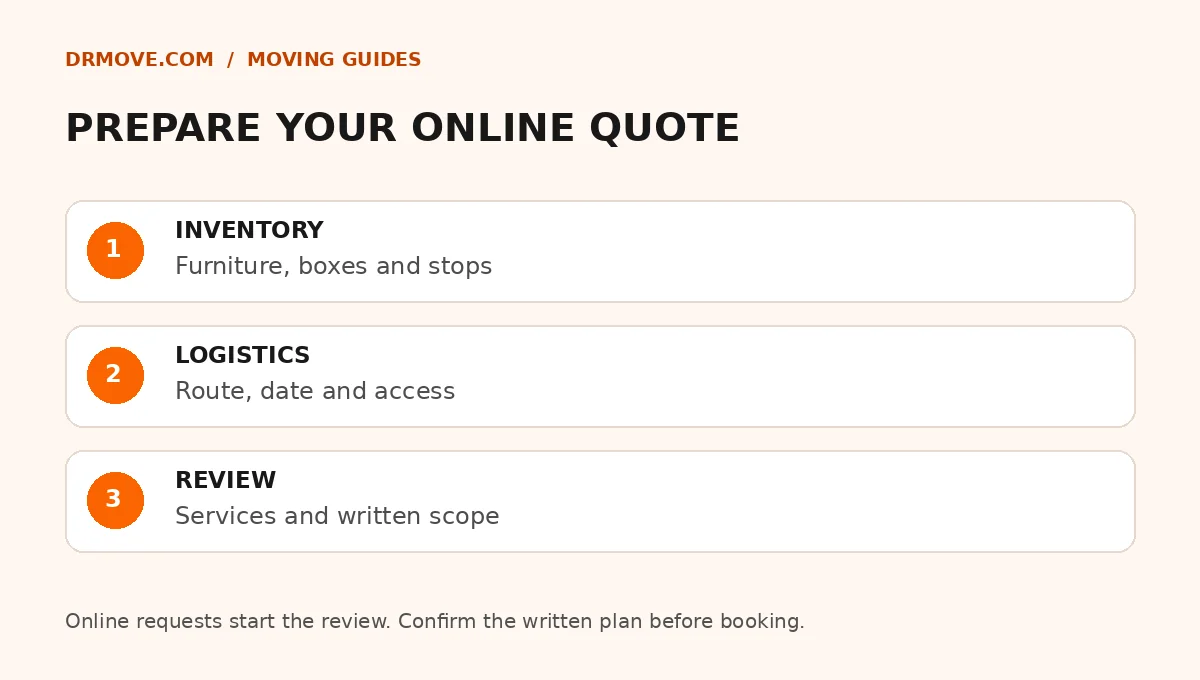
An AI moving quote begins with the facts of the move. The useful inputs are the belongings being transported, the locations, the access conditions, the date and the work you want included. A short statement such as “moving a two-bedroom home” does not describe all of that. Good information helps turn an online request into a scope that can be reviewed.
DrMove’s approach brings moving quote preparation online without an in-home sales estimator. The current public form collects a request for review; it does not itself produce a binding price, take payment or book a crew. This guide explains how to prepare useful inputs and evaluate the written next step. Use this guide to gather your details before requesting a quote, then review the actual written price and booking terms before confirming.
Start my free online moving quote
Start with the route, not just a city name
Provide the pickup and delivery ZIP codes accurately, then identify the actual locations through the appropriate private quoting process when needed. Phoenix is a large place. Two homes with the same city name can have very different travel and access requirements. A provider needs the itinerary of your move rather than a general label such as East Valley.
Describe every stop that belongs in the job. A storage unit, a relative’s home or a separate furniture pickup should be listed before the scope is agreed. State what is being collected or delivered at each point and identify any opening hours that limit access. Do not hide a second pickup inside a general note about the destination.
DrMove’s local rollout starts around Phoenix ZIP 85008 and nearby communities. A city guide is planning information, not confirmation that every address or date can be served. Use the location directory to find relevant guidance, then submit both sides of the actual route so availability can be reviewed.
A home-size label is a starting point, not the inventory
Two one-bedroom apartments can contain very different loads. One resident might have a bed, a small desk and a few boxes. Another might have a sectional, several bookcases, a patio set and a separate storage unit. The same home-size selection cannot communicate those differences. Use it as a summary and describe the belongings underneath it.
Walk through each area and list the furniture, box groups, appliances and other items included. Include garages, patios, balconies, sheds and closets. Count pieces clearly and identify sets with several components. If some belongings will be sold or donated, mark them as excluded rather than assuming the provider will know which pieces disappear before moving day.
Our moving inventory checklist covers the room-by-room process in detail. This AI-input guide explains how those details fit into a quote request. Keep a current version with a date so a later correction does not leave several competing lists circulating among household members and providers.
Describe large, unusual and delicate items separately
Name items that may need an individual review: large furniture, bulky equipment, fragile pieces or belongings whose weight is difficult to judge. Include useful dimensions if the size may affect a doorway, staircase or loading arrangement. Ask how an item should be assessed rather than guessing that its ordinary room category describes the handling required.
If furniture has removable components, explain what is assembled now and what you expect at delivery. Identify whether you are asking for preparation or reassembly and confirm whether it is actually offered. Avoid implying that every appliance, specialty item or installed fixture can be disconnected or handled as routine household furniture.
If a detail needs clarification, follow the instructions provided for sharing photos or additional measurements through the appropriate private process. Keep passwords, financial documents and unrelated personal information out of inventory descriptions or supporting images.
Access details explain the path between the room and the vehicle
Describe the floor level, stairs, elevator availability and the likely loading position at both addresses. Include a long walk, a narrow turn or a building entrance that cannot be used for furniture. These conditions help explain the work that sits between carrying an item out of one room and placing it in another.
Ask the property manager or responsible contact about any reservation, loading window or protective requirement. Rules differ between properties, so verify the actual arrangement. An elevator existing in the building does not automatically mean it can be used at the time you prefer or that a particular piece will fit inside it.
For houses, describe driveway access, steps, gates and the path to the door. For apartments, include both pickup and delivery floor information. Check the destination independently. Sharing the same assumptions for both ends can leave a delivery problem invisible until the vehicle arrives. The furniture measurement guide helps you inspect potentially difficult routes.
Start my free online moving quote
State which services you want reviewed
Separate transportation from packing, preparation, extra stops and other requested work. If you plan to pack yourself, say so. If you need help with certain rooms or items, list them instead of using a phrase such as full service without explanation. Ask what is available, what is included and what remains your responsibility.
Describe the condition in which the provider should expect the belongings. Sealed boxes, loose household contents and furniture waiting for preparation are different starting points. If the packing plan changes, update the request before accepting a final scope. Accurate information makes the comparison clearer even when you are still choosing between service options.
Check instructions about items the provider does not carry or needs reviewed separately. Do not add hazardous materials, unknown containers or specialty goods to the load by assumption. Ask for the actual accepted-item guidance and follow it. This page does not establish that a particular item or service is accepted by DrMove or a participating provider.
Give a workable date and explain what is still tentative
Enter your preferred moving date and identify any alternatives that genuinely work. Explain whether keys, building reservations or another household’s timing remain conditional. A date is more useful when the provider knows which parts are fixed and which parts can change. Do not describe an uncertain closing or access handoff as a guaranteed appointment window.
Separate the date you want from the confirmation you need. The current DrMove form records a preference for review. It does not hold a crew or make a booking. Review the actual written quote and booking terms, and wait for the relevant confirmation before arranging other obligations around a supposedly reserved time.
For the scheduling decision, see how far in advance to arrange Phoenix movers. For a complete preparation calendar, use the 30-day moving checklist. Neither a checklist nor a software-generated acknowledgment replaces the provider’s accepted written arrangement.
Use clear counts and explain uncertainty honestly
You do not need technical language to create a useful inventory. Ordinary descriptions with counts are better than vague room labels. “One dining table, six chairs and a sideboard” tells another person more than “dining room.” “Garage contents still being sorted” identifies a task that must be resolved before that part of the scope can be reliable.
If box counts are provisional, label them as provisional and update them when packing is further along. If an item may be sold, identify that status. Ask how final changes should be communicated. Do not intentionally understate the load in order to obtain a smaller headline number; that makes the resulting comparison less useful to you.
A helpful digital process should make uncertainty visible rather than silently convert it into a guaranteed commitment. Ask questions about anything the form cannot express clearly. Keep a copy of the details you supplied and check the written quote against that copy. Correct an omission before agreeing to the move rather than waiting to explain it on loading day.
Review the written result instead of relying on the AI label
AI-powered is a description of an approach, not evidence that a price includes the work you need. Read the actual inventory, services, route, access conditions and terms. Confirm who is contracting with you and who will perform the service. Check any exclusions or unresolved questions before deciding whether the quote is ready to accept.
A binding moving price concerns the agreed scope in the written arrangement. If that scope changes, ask for a review and a clear written update. Our binding moving quote explanation describes the planning questions. For an interstate move, refer to the official FMCSA consumer resources; an online preparation guide does not replace applicable requirements or the actual provider’s documentation.
Look for a clear next step. Does the message acknowledge receipt, ask for clarification, provide a quote or confirm an appointment? Those are different outcomes. The DrMove intake acknowledgment currently confirms a request, not a guaranteed price or booking. Understanding that distinction helps you decide what to do next without mistaking convenience for a completed agreement.
Protect your household information while getting started
Only include information relevant to the move. You can describe a restricted entrance without putting its access code in a general note. You can identify an important document box without listing its contents or account numbers. If additional private instructions are needed, share them through the agreed appropriate channel with the responsible contact.
Choose a contact method you can monitor while the request is reviewed. Keep the household coordinator informed so a request for clarification does not sit unanswered with someone who is away. Do not send different inventories through several relatives. One current record helps the provider understand what you want considered and which details have changed.
Ready to begin? Gather the route, date, inventory, property access and requested services. Mark the details still awaiting confirmation and send your request online. You can start with Phoenix moving information or the no-home-visit quote guide if you want more context. Clear inputs, a reviewed written scope and an explicit confirmation are the foundations of a better moving plan.